Posted on

Aerial Perspective Mountain Art with 3D Lighting | Watercolor Wildflowers

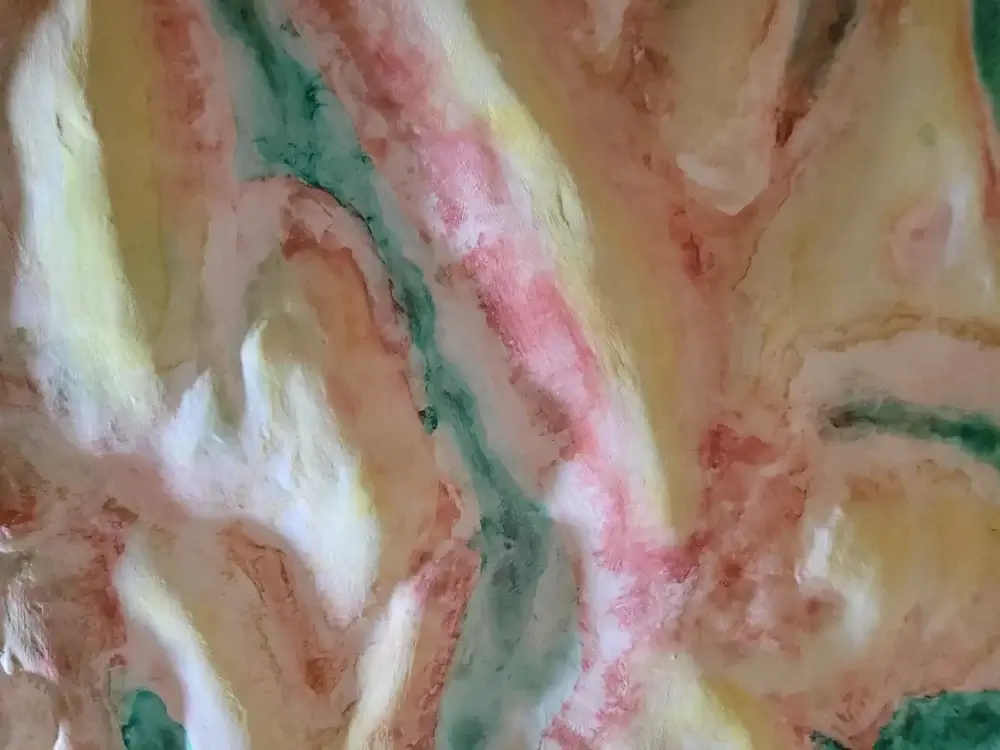
a close view of the watercolor painting illuminated by light at a low sun angle

I’m in love with mountains! I like hiking, scenery, driving and of course painting mountains. So, here’s something totally new! In nearly all landscape art the view is from the side and hardly ever from the top down. Artists try to capture the character of mountains using local color, shape, shadows, light and shading. I thought, what if I could show the color in paint, the shape in relief, and let the light take care of the shadows.

watercolor painting on 3D plaster mountains with lights shining from the bottom inside of a shadowbox
lights illuminate the desert landscape in this 36″ x 36″ watercolor painting on 3D plaster mountains

Here’s a photo of what I designed and developed as an art form to more intuitively portray the look of mountains from an aerial perspective. It is a bit abstract but I like abstract paintings that give the mind something to look for. In this case it is the coloring of the desert as the sun sets and part is warm exposed by the sun and part is cool where the light does not fully reach. This scene transitions from warm to cool from south to north. I could imagine the shape of shadows but why not create the mountains with three dimensional shape and add lighting to solve the location of where sunlight reaches the terrain?

watercolor painting on 3D plaster mountains with lights shining from the bottom inside of a shadowbox
lights illuminate the desert landscape in this 36″ x 36″ watercolor painting on 3D plaster mountains

A shadow box is used to block ambient light from illuminating the mountains from the side. The 6″ bottom shelf is a little bit wider than the 4″ sides to allow the lights to be placed at a low sun angle (but not too low). The lights are battery powered LED with a remote control. I plan to make other versions of this and this one is for sale for only $350 frame and lights included. Free shipping.

Shop Now

Posted on

Mastering Depth and Color in Watercolor: Poppies and Thistles Painting

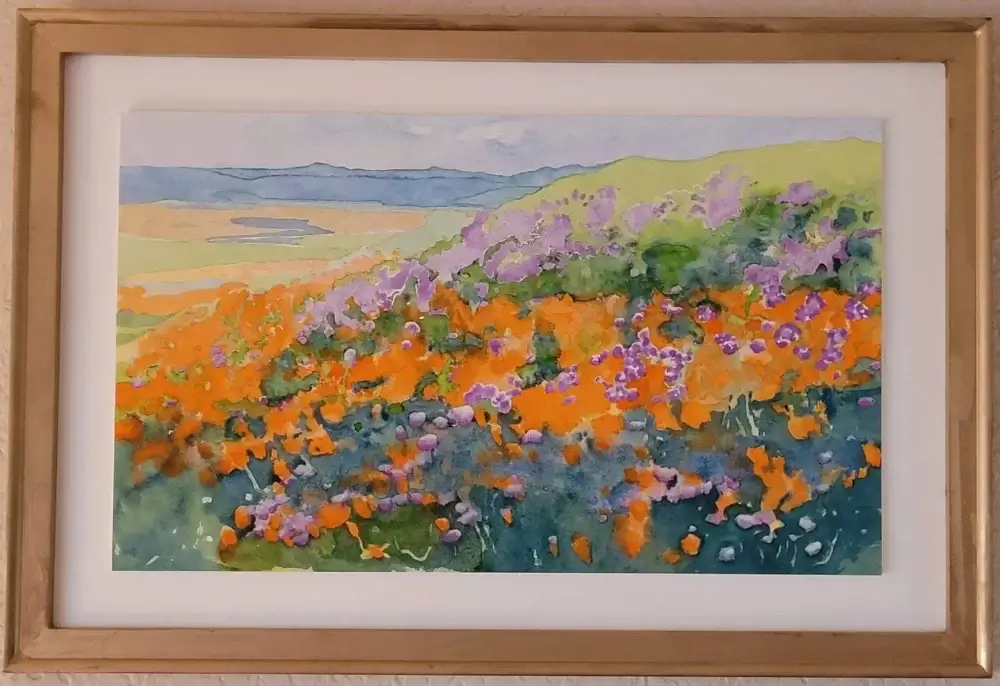
gold framed "Poppies and Thistles", watercolor painting

Painting secondary colors with watercolor is a challenge. Painting Poppies and Thistles is a recipe for disaster. The problem is blending. Getting the appearance of a wide hillside filled with orange and purple and green with flowers in descending size (receding distance) increases the likelihood of mud. Mud happens when you mix any two secondary colors because they are opposites. Its yellow-red, blue-red, and blue yellow. Any mixture puts a third primary into the mix, which equals what can be a horrible color.

I’ve tried to overcome the problem with green by painting a layer of blue and using a transparent overlay of yellow. If I’ve got orange and blue next to each other and I overlay yellow into the orange, that is OK. But I can’t let any of the yellow overlay the purple.

This painting, “Poppies and Thistles” took much longer to paint than I imagined. Controlling location, values, colors, and pushing and pulling to get a believable depth, were some of the additional challenges.

Poppies and Thistles watercolor painting
Poppies and Thistles in watercolor, 27″ x 16″
Gold framed landscape painting hanging on a beige wall. The painting has orange and purple and green elements in the foreground.
Gold framed landscape painting hanging on a beige wall. The painting has orange and purple and green elements in the foreground with light green and light blue background.
Posted on

Unique Framing Solutions for Non-standard Artwork | Art to Frame

AI generated scene of tiny artist with large paintbrush and abstract painting in front of many gold frames.

Framing Art can be a tricky business and expensive. I try to use standard size sheets of watercolor so that the artwork can be easily framed. Not everything is standard however. I like using Arches 10″ x 14″ pads of 140 lb cold press. There aren’t many frames out there for 10″ x 14″ openings. A solution I have found is Art to Frames Inc or arttoframe.com in Brooklyn, New York 718-788-6200.

On their website you can enter the size of the opening (next smallest integer inch) to see what your options are for frames and matting. As an example, I would enter 9″ x 13″ since it is the next smallest integer. If the paper was 10.5″ x 14.5″ then I would enter 10″ x 14″ for the opening. On the left side of the web page be sure to check Frame + Single Mat. The outer frame size will be 16.5 x 20.5 inches. This can be checked in the product information before you add to cart.

Play around with this page to see what looks best. You can even upload a photo of the image (should be same aspect ratio as the opening) to see what the frame and artwork will look like together!

Art to Frame web page