

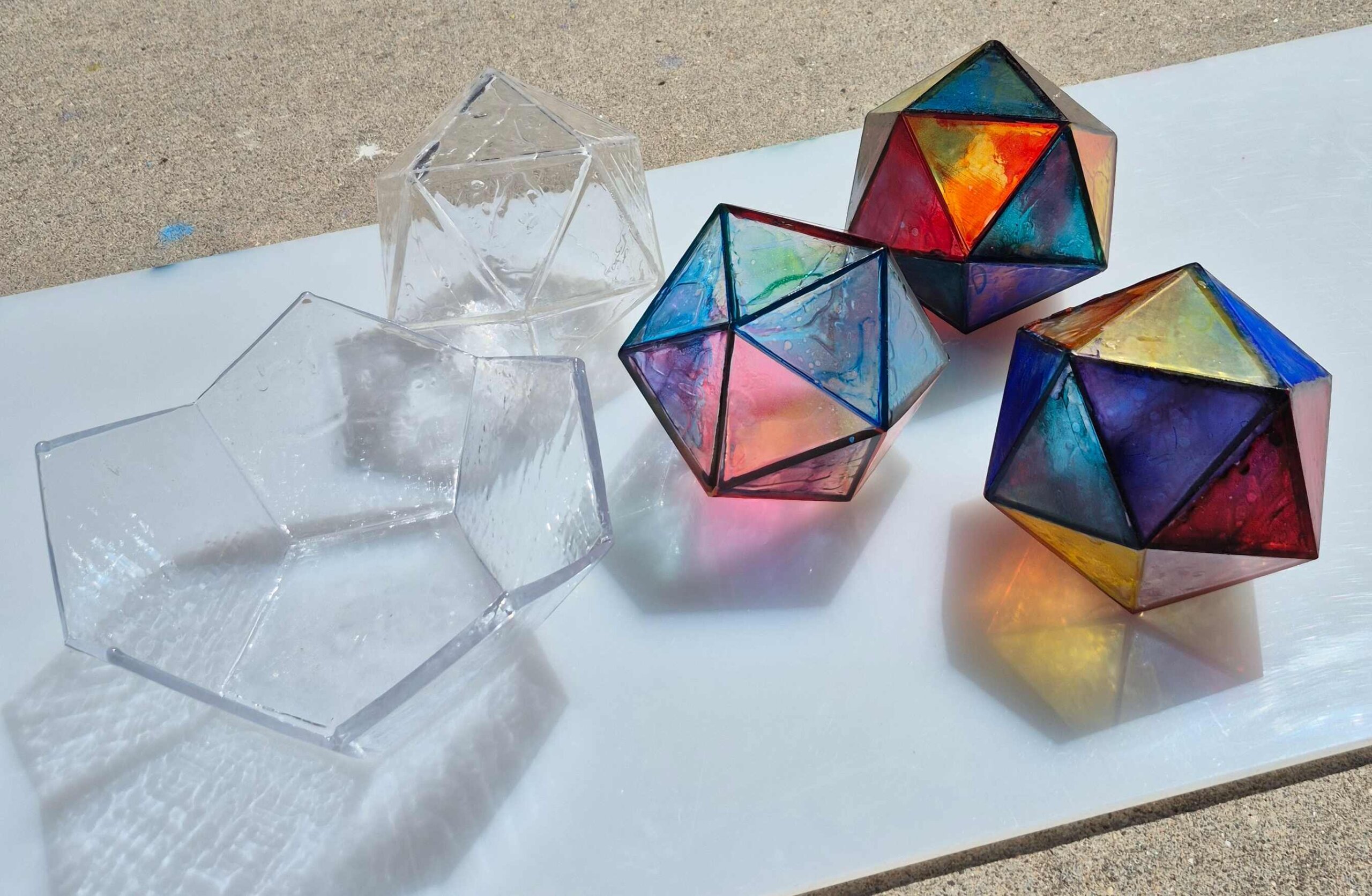
It’s Summer! Watercolor Wildflowers Monthly Newsletter here featuring a rainbow Icosahedron. What’s that? Read on.

This month’s winner of a Planetary Nightlight is Robert at RobertLovesPi.net, a very cool blog about polyhedra and tessellations. Subscribe to my newsletter for a chance to win!
ENTER Drawing by -> SUBSCRIBE
Customer Newsletter July 2025
Rainbow Icosahedron in Resin
Exploring the intersection of art and science, the Icosahedron embodies principles of symmetry and balance. Its structure has fascinated mathematicians and artists alike, inspiring countless creative projects. At my studio I’ve kept going with the Icosahedra idea (plural of Icosahedron). Its like a geodesic dome but all the way ’round. The trick is finding best way to assemble these beveled equilateral triangles. Mathematically, it will fit. The best outcome requires precisely made 60° resin triangle chips of equal thickness. Beveled edges of 15° are sanded on my vertical belt sander.
Alcohol Pigment
I’ve found alcohol pigment is a good way to color the hard resin after the sanding and clean-up. Primary and secondary 3″ colored triangles are distributed evenly. Each Icosahedron has 20 triangles. So I make 3 red, 3 blue, 3 yellow, 3 violet, 3 orange, 3 green (rainbow) and then 2 clear triangles. The coloring may be simple but its the best way to avoid muddy (tertiary) color accidents.
Alcohol pigment effectively colors the cured resin post-sanding and cleanup. Each Icosahedron comprises 20 evenly distributed colored triangles. The distribution includes 3 red, 3 blue, 3 yellow, 3 violet, 3 orange, 3 green (rainbow), and 2 clear triangles. This simple coloring method helps me prevent undesirable muddy colors. Muddy colors are the mixing of less bright, less clear, tertiary colors by accident. I want these Rainbow Icosahedron to be mesmerizing and fun to look at.

How to Assemble an Icosahedron in 20 Pieces
I found the best way to assemble the Icosahedron from studying the unfolding diagram. Unfolding diagrams show what elements make up a three-dimensional object (flattened pieces). Turns out you start with the middle.

The middle band of 10 triangles up then down should be taped edge-to-edge on a smooth flat surface with 1/2″ masking tape. Carefully raise the chain of triangles onto its side and curl it into a circle. Tape that last triangle to the start of the circle. I carefully add more masking tape, tightening and holding the triangles more firmly together. This makes a crown where curiously one triangle tips inward 5° and the next triangle tips outward by about 5°.
I form the top pentagon as five triangles pointing into the middle and pulled up at the center. Starting these shapes with masking tape saves a lot of frustration. Add the top to the crown. Match, fit and tape edges tightly together in all directions.
The bottom pentagon goes on the same. If made with near-exact equilateral triangles, then a tight fit can be achieved. The taped pieces are glued together carefully with tiny resin welds between tape.


Finishing the Rainbow Icosahedron
All of these get a clear resin finish. I’m trying different pigments and transparency ideas. And I’ve got some one-way mirror film that will create an infinity effect. You’ll see forever next month as well as some food-safe stylish Pentagon Bowls!
CALL OR VISIT MY STUDIO 5069 Leavenworth Street Omaha, NE 68106 (402) 943-7516
Share Socially

Discover more from Watercolor Wildflowers Resin Artist
Subscribe to get the latest posts sent to your email.
You must be logged in to post a comment.