Watercolor Wildflowers is studio artist business. John Meng-Frecker is a retired civil engineer surveyor - I make resin art ornaments, lighthouses, nightlights, geometric art, resin paintings, and I do other graphic arts related services like framing and hanging installations. My resin slab designs are geometric themes and color compositions. Art pieces are transparent, colorful and illuminated with LED by AC or battery power. Shipping of online purchase is free and local Installation in Omaha area is included with purchase.My resin art is unlike any other and will look incredible in your home or business. My paintings are planned, well constructed, and beautiful. Hang them on your wall or in front of a window. I've built LED backlighting which shines brightly through the colorful resin. Made-to-order and Commissions 4029437516.
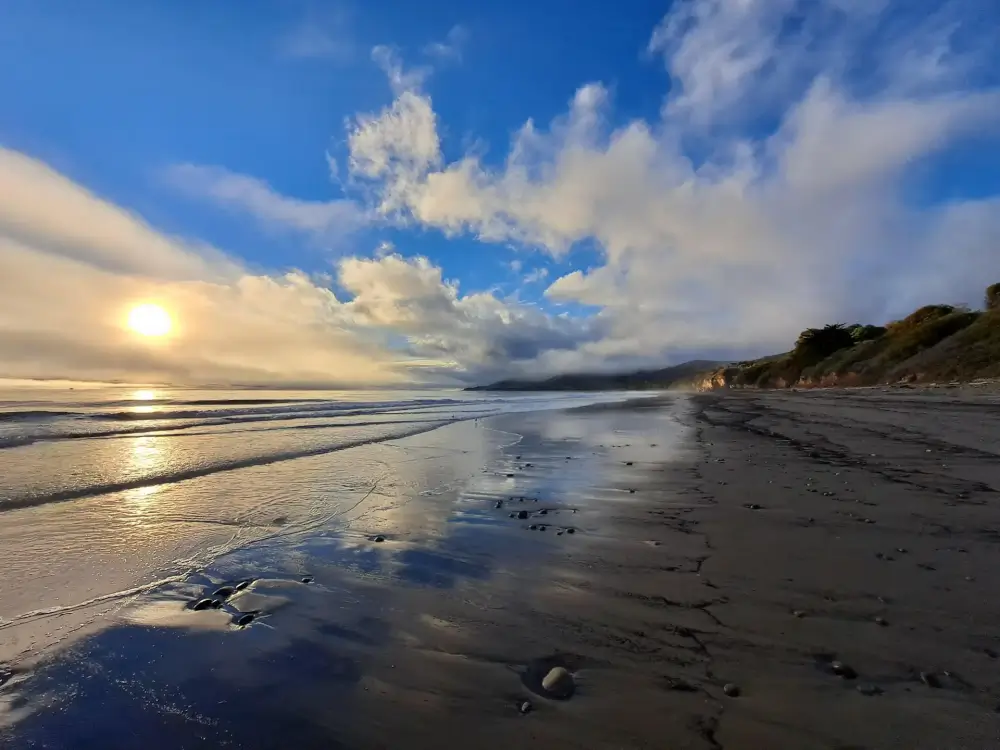
Just north of Santa Barbara, this campground and adjacent beach offers easy ocean access and some nice views north and south. While walking the beach I saw dolphins popping up near shore as they chased a school of dinner between them and the shore.
I like to walk at “magic hour” when the shadows are long and the light changes in dramatic ways. I chose this scene because of the exposed sedimentary layers tipped by uplifting forces underneath. In the sunset light the usually boring layers of earth were electrified in front of me.
Coastal Geology Exposed and Lit by Sunset
I came back the next day with pencil and watercolor paper pad to capture the composition. Because the light changes so fast in “magic hour” you can’t hope to watercolor en plein air. The painting below was composed on site in pencil but the watercolor was added later in my mobile studio while looking at the Sunset photo.
11″ x 14″ study of erroding cliff along the beach in Southern California. The painting began as a study in the late afternoon with the western sun shining warmly on the reddish soil causing an orange cast on the exposed layers of soil. Coniferous trees green in winter contrast with the orange light.
I tend to exaggerate colors especially where there is an interesting color or adjacency. The combination of sunset lighting and my emphasis on colors may be a bit much for some but I like it, for the present.
The end of magic hour is darkness. It falls fast so keep your camera going.
framed original painting of shore rocks at sunset from photo by the artist taken at El Capitan Beach in Southern California.
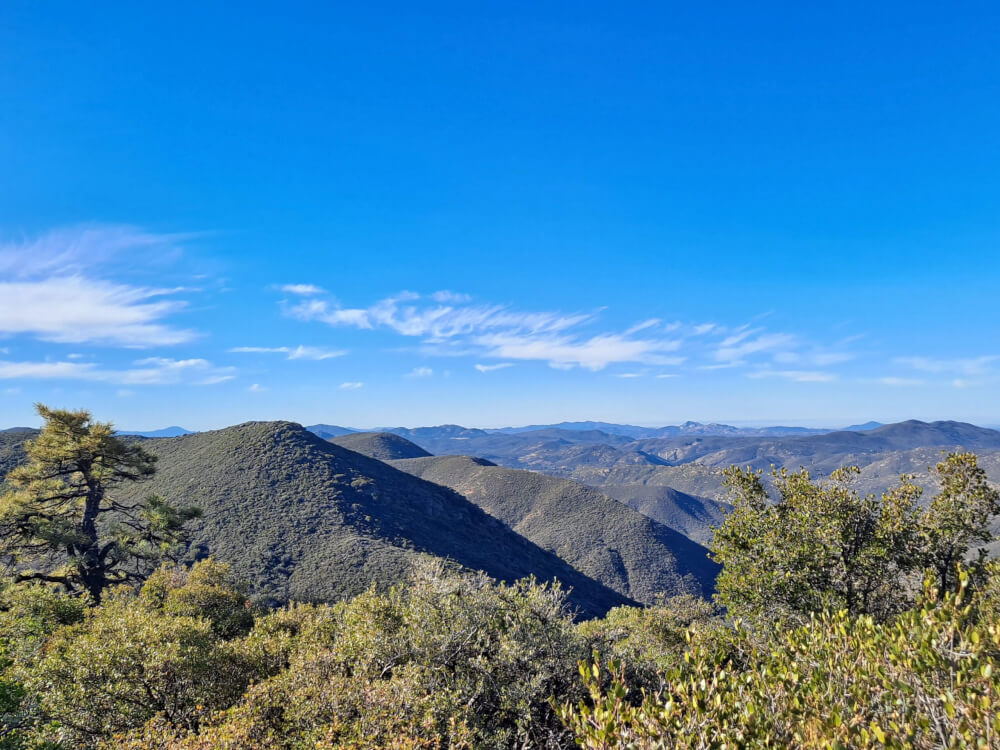
The early morning view from Mt Laguna is inspiring. Light bends at the horizon to create prismatic colors orange, green, and blue. The blue of the sky becomes deeper further up into the atmosphere. Having telescopes there makes sense because of the dark skies far from city lights.
Mt Laguna is a favorite winter play spot for people from San Diego just an hour west by car. The altitude makes for colder nights and sometimes snow. The air is dry and clear so it is easy to see for a long distance. From this height and direction you can see Arizona and Mexico.
My painting is a studio painting because the light was changing fast. I wanted to include the telescope / Observatory to create interest in the composition. Also a nod to my father who built motor drives for telescopes at Kitt Peak and Mt Lemon in Tucson where I grew up. He worked for the University of Arizona but moved to Tucson after the Navy in San Diego. He may have spent some time at Mt Laguna Observatory.
Here’ the layout and the painting.
Layout of Values and Color NotesMt Laguna Observatory watercolor painting
If you have Google Earth installed on your computer, you can visit this location at https://earth.app.goo.gl/?apn=com.google.earth&isi=293622097&ius=googleearth&link=https%3a%2f%2fearth.google.com%2fweb%2f%4032.84441267,-116.44367935,2045.45556288a,0d,35y,102.33302563h,88.75721883t,0r The red line is the Pacific Crest Trail. The Peak is Mt Laguna.
The core of me is art. I want to be an artist – a good artist. The mission of this trip is to paint en plain air on a regular basis, daily if possible. It took three weeks for me to reach the point where I could sit in front of my landscape subject and draw and paint. In getting here, I was met with logistical challenges, mental and physical challenges.
For the first en plain air location I chose a desolate location with complex topography and simple colors. Desolate because I fear people looking over my shoulder. Not because it matters but because it challenges my confidence. Much like public speaking, your ideas, talent, and personality are on display and open to criticism.
Anacapa Island is volcanic rock with a little dirt spread like frosting on the top. It is a critical navigation point opposite Ventura marking the west side of the Santa Barbara Channel. In fact, Anacapa is the furthest east island of The Channel Islands an holds a functional lighthouse.
Anacapa Island Lighthouse
While painting on location,, what I realized is that I could map the shadows to help create an authentic character of the scene. I drew what I could see for shadow shapes and later filled those in with my near darkest values. Here’s the photograph when I began drawing my pencil outlines of shapes.
South Anacapa – photo of watercolor painting position
I mentally assigned values between 1 and 10 to the top of the sky, horizon sky, ocean, shadowed ocean, sunlit land, and shadowed land.
Mixing colors with Nita Engle’s pallete of reds, blues and yellows turned out to be intuitive because she has thought through and practiced the most frequent color mixing. Here’s the result. Not a masterpiece but it captures the scene. This plein air painting was done in three hours including set-up and under drawing.
South Anacapa – watercolor en plein air
If you have Google Earth installed on your computer you can visit this location at https://earth.app.goo.gl/?apn=com.google.earth&isi=293622097&ius=googleearth&link=https%3a%2f%2fearth.google.com%2fweb%2f%4034.0109181,-119.37578355,-0.80644256a,1062.93184534d,35y,-112.97140112h,82.10455027t,360r The cliffs are amazing and dramatic in Google Earth.






You must be logged in to post a comment.